
You ask. She shrugs. “Fine.” Three seconds, conversation over, and you’re left standing in the kitchen wondering when your kid became a locked door. This isn’t defiance — it’s the predictable result of asking a question the brain has already learned to answer on autopilot. Questions to ask kids that actually get real answers work differently, and the difference comes down to psychology, not luck.
Questions to ask kids are prompts designed to bypass the automatic, low-effort answers that generic questions like “how was school” produce. Instead of asking for a summary, they ask for a specific memory, opinion, or sensory detail — something a child’s brain can’t answer with one flat word.
Why “How Was School” Fails and Better Questions Don’t

“How was school” is what psychologists call a global evaluative question — it asks a child to summarize eight hours into one judgment. That’s cognitively hard for anyone, and children’s prefrontal cortices, which handle this kind of retrospective synthesis, aren’t fully developed until their mid-twenties. Research on autobiographical memory by psychologist Robyn Fivush shows that children recall specific, sensory, or emotionally charged moments far more easily than they can generate broad summaries.
Think of a child’s memory like a junk drawer, not a filing cabinet: nothing is organized by category, so asking for “the day” forces them to rummage blindly. Asking about one specific object — a smell, a moment, a face — lets them reach in and pull something out immediately. The common misconception is that kids who give one-word answers are being sullen or secretive. Often they’re just cognitively stuck, not emotionally closed.
Where the Right Question Changes Everything
The Car Ride Home
Eight-year-old Marcus stares out the window, backpack still zipped, and his mom asks, “What made someone laugh today?” His shoulders drop half an inch before he answers. Specific, positive-affect questions activate episodic recall tied to emotion, which is stored more vividly than neutral information. Parents miss this window because the car feels like transition time, not conversation time — but low eye contact is exactly what makes kids talk more freely.
The Dinner Table
Priya, ten, pushes rice around her plate while her dad asks, “What’s something that felt unfair today?” She looks up, surprised someone asked. Naming unfairness taps a child’s developing sense of moral reasoning, which researchers like Elliot Turiel have shown emerges earlier and more strongly than adults assume. Parents often skip this because they brace for complaints, missing that it’s actually a rare invitation for the child to feel heard.
Bedtime
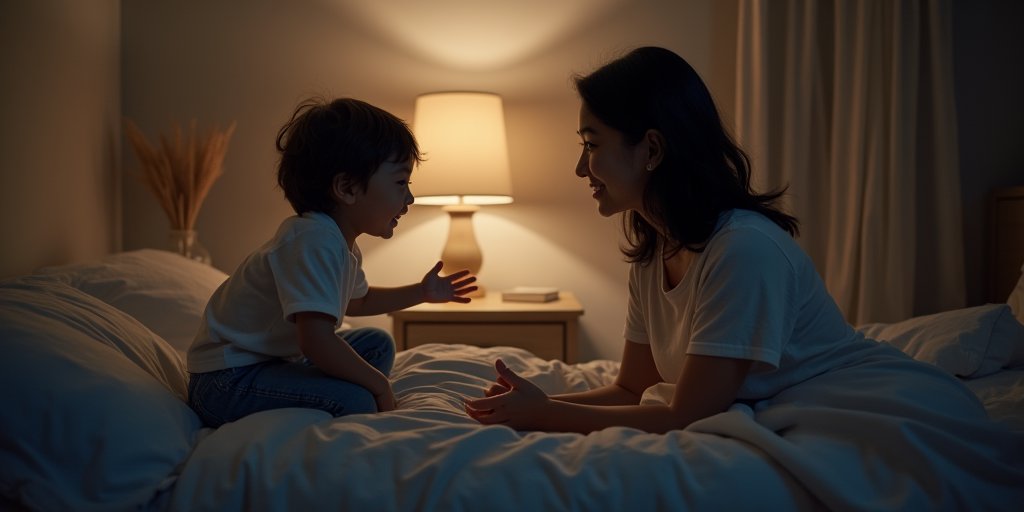
Noah, six, is half under the covers when his mother asks, “What do you want to dream about?” He grins and starts narrating an elaborate space battle. This works because bedtime lowers a child’s guardedness — the day’s demands are over, so there’s nothing left to perform for. It’s easy to miss because parents are focused on winding down, not opening up, right when the child is most relaxed and honest.
Where It Gets Complicated
What most listicles miss is that the “right” question isn’t universal — it depends on the child’s temperament and the power dynamic in the room. Developmental psychologist Jerome Kagan’s research on temperament found that high-reactivity children often shut down further under direct, face-to-face questioning, while the exact same question asked side-by-side (in a car, on a walk) produces the opposite effect. The format of the question matters as much as its content.
There’s also a contrarian point worth sitting with: asking better questions can become its own form of pressure if a child senses they’re being interviewed rather than talked to. Occasional silence, or a question left unanswered, isn’t a failure — it’s information. The American Academy of Pediatrics’ guidance on parent-child communication notes that consistency of check-ins matters more than the cleverness of any single question.
Signs You’re Still Asking on Autopilot
Here’s how to recognize when generic questioning is shaping your conversations with your kids:
- The one-word loop: You ask a question and get “fine,” “good,” or “okay” more than three times a week without follow-up.
- The interview stance: You’re facing your child directly, making eye contact, expecting a full report the moment they walk in the door.
- The timing mismatch: You ask your biggest questions in the first sixty seconds of reunion, before they’ve decompressed at all.
None of these are parenting failures. They are predictable responses to a question format that doesn’t match how kids actually retrieve memory.
- The topic narrowness: Nearly all your questions are about academics or behavior, rarely about feelings, friendships, or imagination.
- The silence discomfort: You jump in to fill pauses instead of letting your child sit with the question for a few seconds.
Recognizing these patterns isn’t about guilt — it’s diagnostic information you can use immediately, starting with your very next car ride or dinner.
Research-Backed Ways to Ask Better

Research points to specific approaches that can interrupt this pattern — though none are instant fixes.
Use Specific, Sensory Prompts
The principle: specificity narrows the search field in memory, making retrieval easier. Try asking about one concrete moment — “What was the funniest thing you saw today?” — instead of the whole day. It won’t work every time; some days genuinely felt uneventful to a child, and that’s a fine answer too.
Change the Physical Setup
Side-by-side positioning (driving, walking, doing dishes together) reduces the social pressure of direct eye contact, a principle borrowed from motivational interviewing techniques used in therapy. Save harder emotional questions for these lower-pressure setups rather than face-to-face check-ins. This requires planning your timing, which isn’t always realistic on busy days — see more on building consistent family routines for support with that.
Follow Curiosity, Not a Script
Whatever your child mentions first, ask one genuine follow-up question about it rather than moving to your next prepared question. This signals real interest rather than data collection, according to research on parent-child conversational responsiveness. The caveat: this only works if you can tolerate not covering everything on your mental checklist in one sitting.
Frequently Asked Questions
What is the best question to ask a kid after school?
There’s no single best question — it depends on the child’s age and mood — but specific, sensory prompts like “what made you laugh today” consistently outperform broad ones. The key is asking about one moment, not the whole day.
Why does my child give one-word answers to open-ended questions?
Often it’s not defiance but a memory retrieval problem — global questions like “how was school” are genuinely hard to summarize, especially for younger kids. Narrower, more specific questions bypass this difficulty.
How many questions should I ask my kid at once?
One is usually enough. Stacking multiple questions can feel like an interrogation and often causes kids to shut down rather than open up, especially with more reserved temperaments.
The Real Reason Kids Open Up — Or Don’t
Back in that kitchen, “fine” was never really about secrecy — it was a hard question meeting an underdeveloped filing system. Ask about one specific moment instead, in a setting with less direct pressure, and the same child who shrugged will often talk for ten minutes.
The questions that work aren’t magic — they simply match how a child’s memory and nervous system actually function.
The next time you get “fine,” consider that you didn’t get a bad answer — you asked a question no memory could easily answer.