The Gap No One Talks About
You replay the meeting on the drive home. You said something — maybe too blunt, maybe too eager — and now you’re constructing what everyone in that room thought of you. The version you build is detailed, coherent, and almost certainly wrong. This is the central problem with trying to see yourself how others see you: you don’t have access to their data. You only have yours.
The uncomfortable truth is that other people are not seeing the person you think you’re presenting. They’re seeing behavioral patterns you’ve long stopped noticing, emotional tones you can’t hear in your own voice, and a version of your face that you have literally never seen in real time. The gap between your self-image and how others perceive you isn’t a flaw in your character — it’s a structural feature of how human perception works. But understanding why the gap exists is the first step to actually closing it.
How to see yourself how others see you refers to the practice of closing the gap between your internal self-image and the impression you actually make on other people. This gap exists because your self-perception is built from your intentions and inner experience, while others can only observe your behavior — and the two rarely line up as cleanly as you assume.
The Science Behind the Blind Spot
In 1902, sociologist Charles Cooley introduced the concept of the looking-glass self — the idea that our self-concept is built not from who we actually are, but from our imagination of how others perceive us. A century later, that theory has been refined into something more precise and more troubling: we’re often wrong about what’s in the mirror.
Psychologist Simine Vazire’s Self-Other Knowledge Asymmetry (SOKA) model, developed through studies published in the Journal of Personality and Social Psychology, maps exactly where this breaks down. The self is a reliable judge of internal states — anxiety, intention, effort. But for visible traits like warmth, dominance, or creativity, strangers and close friends consistently outperform self-reports in accuracy. You know what you mean. They know what you do.
Meanwhile, research by Thomas Gilovich, Victoria Medvec, and Kenneth Savitsky at Cornell University demonstrated the spotlight effect: people systematically overestimate how much others notice their appearance and behavior. In their studies, participants wearing an embarrassing T-shirt estimated that roughly half the room noticed it — the actual figure was closer to 25 percent. The spotlight you feel on you exists almost entirely in your own mind.
Think of it this way: your self-image is like a manuscript you’ve been editing for years. You know every intended meaning, every deleted draft, every paragraph that almost didn’t make it in. Other people are first-time readers. They have no access to your intentions — only to the words on the page.
The surprising finding that changes how most people think about this: organizational psychologist Tasha Eurich’s five-year research program found that while 95 percent of people believe they are self-aware, only 10 to 15 percent actually are by measurable criteria. The problem isn’t that people refuse to examine themselves. It’s that introspection alone — replaying your own thoughts and feelings — is a poor tool for understanding how you come across. Looking inward doesn’t show you what’s visible outward.

Where the Gap Shows Up in Real Life
The Confident Person Who Reads as Arrogant
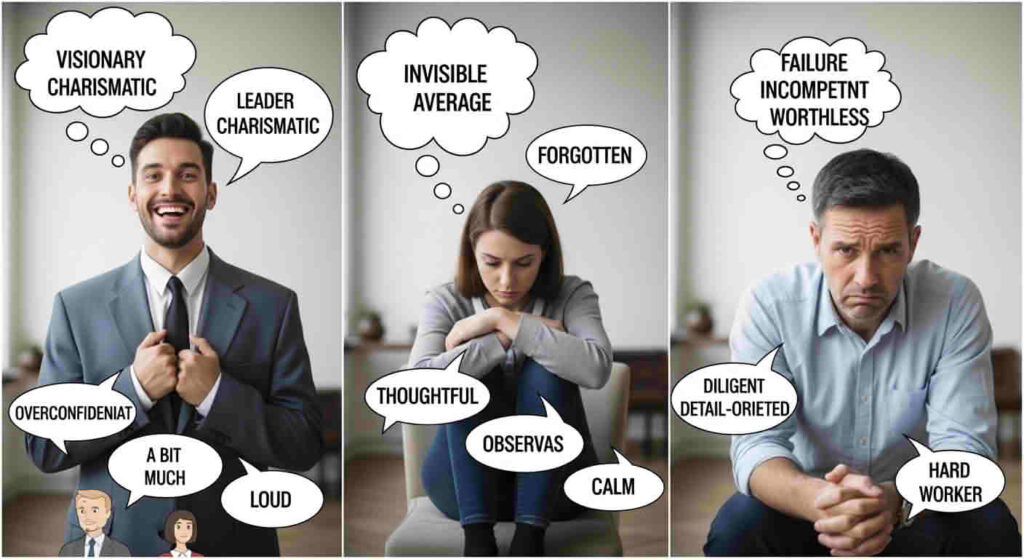
Marcus has given the same kind of direct, no-small-talk answer in team meetings for three years. To him, it’s efficiency — he respects everyone’s time. By Thursday afternoon, when a colleague finally tells him he “can seem dismissive,” he feels genuinely blindsided. The mechanism here is what psychologists call the intention-behavior gap: Marcus encodes his behavior with the meaning he intended; his colleagues decode only what they observe. His internal experience of respect never made it into the room. And in the moment, he had no feedback loop to tell him it hadn’t.
The Quiet Person Who Reads as Cold
Priya is processing. She does this silently, and always has — working through a problem internally before she speaks feels natural and careful to her. But at 4 p.m. on her first week in a new job, someone says, “You seem a bit hard to read.” She’s confused. She wasn’t hiding anything. The gap here is between the signal she thought she was sending — thoughtfulness — and the one being received: distance. Others can’t see internal processing. They can only see its absence in the conversation.
The Self-Critic Who Reads as Self-Assured
Jamie spends Sunday night rehearsing everything that could go wrong in Monday’s presentation. She feels transparently nervous, certain the tremor in her voice will give her away. Her colleagues later describe her as “composed” and “authoritative.” This is the spotlight effect in action — Jamie’s internal experience of anxiety is vivid and consuming, so she assumes it’s equally visible. But emotion doesn’t broadcast at the volume it feels. What reads as enormous on the inside registers as ordinary on the outside, and often disappears entirely.
How to Recognize When the Self-Perception Gap Is Shaping Your Behavior
Here’s how to recognize when the gap between your self-image and how others see you is actively influencing your life:
- You’re repeatedly surprised by feedback: When feedback from multiple different people in different contexts keeps catching you off guard — particularly on the same trait — it’s a reliable sign that your self-model is missing something real.
- Your explanations focus on your intentions: When challenged on your behavior, you find yourself immediately explaining what you meant — “I was just trying to help” — rather than addressing what was observed. Intentions are real, but they’re invisible to everyone except you.
- You assume anxiety or effort is showing: You avoid speaking up because you’re sure your nervousness is obvious, or you stop trying because you assume the effort is already visible. This is the spotlight effect narrowing your behavior based on a signal no one else is receiving.
None of these are character flaws. They are predictable responses to the structural limits of self-perception — limits that apply to nearly everyone.
- You’re more consistent in how you see others than yourself: You notice patterns in other people quickly — “she always deflects with humor,” “he tends to dominate when he’s insecure” — but find yourself puzzled or defensive when others name patterns in you. This asymmetry is exactly what the SOKA model predicts.
- Photographs and recordings feel wrong: Your voice on a recording, your posture in photos, your expression mid-conversation — all feel like inaccurate representations. They’re not. The dissonance is between the you that lives inside your head and the you that exists in the observable world.
Recognizing these patterns is genuinely useful — not as a source of shame, but as a calibration tool. The goal isn’t to abandon your internal perspective. It’s to hold it a little more loosely and stay curious about the version of you that others are actually experiencing.
What Research Suggests You Can Actually Do
Research points to specific approaches that can interrupt this pattern — though none are instant fixes.
Seek Behavioral Feedback, Not General Opinion
The psychological principle: vague feedback (“you seem distant”) is hard to act on and easy to dismiss; specific behavioral feedback (“you didn’t make eye contact during the first half of the meeting”) bypasses defensiveness and gives you something observable to work with. In practice, ask a trusted person not “how do I come across?” but “can you describe something specific I did in that conversation that stood out to you — positively or negatively?” The caveat is that this requires genuine psychological safety in the relationship, and it may take several attempts before people offer something real rather than something kind.
Use Cognitive Defusion to Separate Your Story from the Data
Cognitive defusion — a core technique from Acceptance and Commitment Therapy (ACT) — involves creating distance between yourself and your self-narrative. When you notice yourself thinking “I come across as confident and direct,” defusion asks you to treat that as a thought rather than a fact: “I’m having the thought that I come across as confident and direct.” This small linguistic shift does something important: it loosens the grip of your self-image and makes you more available to contradictory evidence. Applied specifically to self-perception, you might practice noting the gap between your self-story and any piece of external feedback without immediately resolving the tension. The Association for Contextual Behavioral Science has published resources on applying cognitive defusion in daily practice. The caveat is that defusion alone doesn’t give you new information — it just makes you less resistant to receiving it.
Watch Yourself the Way Others Do
Recording yourself — in a presentation, a casual conversation (with consent), or even a self-facing video — gives you access to behavioral data you’ve never had. Tasha Eurich’s research suggests that most people’s perception of themselves shifts meaningfully after watching recordings of their own behavior, specifically because it bypasses the internal narration they normally rely on. Start with low-stakes situations: a practice presentation, a video journal entry. The discomfort of watching is itself useful information — the instinct to look away from the recording is the same instinct that maintains the gap in everyday life. You can also explore how self-awareness connects to emotional intelligence and leadership for a broader context on why closing this gap has measurable real-world effects.
Read more: Why Grief Comes in Waves – And How to Recognize Your Own Pattern
Read more: The Real Psychology Behind Why People Fight for Change
Frequently Asked Questions
Is it possible to ever fully see yourself the way others see you?
Not fully — and that’s not a failure. Some aspects of your personality are genuinely better known to close observers than to yourself, while others (your inner emotional landscape) will always be more accessible to you than to anyone else. The goal isn’t perfect external vision but a more calibrated self-model that can hold both perspectives simultaneously.
Why does my voice sound different on recordings — is that how others really hear me?
Yes. The voice you hear while speaking reaches your ears partly through bone conduction inside your skull, which adds a richness and depth that external listeners don’t hear. Recordings capture the airborne sound everyone else receives. The dissonance you feel is real, and it’s one of the clearest examples of how your self-perception is built from data no one else has access to.
Does getting feedback from more people give you a more accurate picture of how you come across?
Generally yes, but with an important nuance: aggregate feedback from multiple people filters out individual biases and idiosyncratic impressions. However, the people giving feedback still share your cultural context, relationship dynamic, and situational framing — so even broad feedback has systematic blind spots. Diversity of context matters as much as quantity of feedback.
Why do I keep being surprised by the same feedback even after I’ve heard it before?
Because hearing feedback doesn’t automatically update your self-model — especially when the feedback conflicts with a long-held self-narrative. The brain tends to encode identity-inconsistent information as the other person’s error rather than new data. Techniques like cognitive defusion from ACT therapy are specifically designed to interrupt this defensive filtering and make the information available to be processed rather than immediately rejected.
The Mirror You Never Had
Go back to that drive home after the meeting. The version of yourself you were reconstructing — the one that said the wrong thing, or too much, or at the wrong pitch — was built from intention, memory, and a spotlight that wasn’t actually on you. The room moved on faster than you did. The impression you left was different from the one you feared, and probably different from the one you hoped for too. That’s not a crisis. That’s just the condition.
The self is not a fixed object that others are trying to see clearly. It is a moving, context-dependent performance that you are always inside of and never able to watch from the outside. Closing the gap between your self-image and how others see you isn’t about achieving perfect self-knowledge — it’s about staying genuinely curious about the distance between them.
The most honest version of self-awareness isn’t “I know exactly how I come across.” It’s “I know I have a blind spot, I take that seriously, and I keep asking.”